
Conversations that inspire action for Knysna’s environment.
For the past 29 months, Talk of the Town has brought scientists, conservationists, and passionate locals together at Knysna Yacht Club. Each talk sparks conversation about our estuary, ocean, and biodiversity.
Your support makes a difference — proceeds from every talk go directly into our community conservation outreach, and education programmes for township youth.
Now Proudly Sponsored by our Guardians of Knowledge:


Upcoming Talks
Stay curious and join us at our next events:
22nd September 2026:
Climate Change? Think Landscape! A Landscape Strategy for a Resilient Knysna Shoreline
Want monthly reminders? Join our WhatsApp group for updates on upcoming talks
Past talks
Over 29 months, we’ve hosted inspiring conversations on Knysna’s stingrays, estuary health, sustainable fishing, invasive species, and more.
Explore highlights below (click to read more or watch the videos on Instagram):
2024
Dr Chantel Elston: Dive into the World of the Blue Stingray!
21st May 2024: This was an exciting talk about the Blue Stingray (Dasyatis chrysonota) in the Knysna Estuary! Discover fascinating facts about these graceful creatures and the ongoing research in their natural habitat. Did you know that blue stingrays can grow up to 75 cm in disc width and often give birth to 1-5 pups at a time? They have a unique reproductive strategy where the embryos feed initially on yolk and then receive additional nourishment from the mother via specialized uterine structures. These stingrays are key predators in their ecosystem, feeding on a variety of benthic organisms, including crustaceans and mollusks. Their gentle nature makes them harmless to humans, yet their role in the marine food web is crucial.
Alan Whitfield, Kyle Smith, and Jessica Seath: The white steenbras and the future of the Knysna Estuary
25th June 2024: shed light on the endangered white steenbras in the Knysna Estuary. Discover the fascinating history, current status, and critical conservation efforts for this iconic species.
Dr. Deborah Robertson-Andersson: Whales and human culture – a deep dive into our connections
30th July 2024: She is a renowned expert in integrated multi-trophic aquaculture and has shifted her focus towards promoting human connection with nature. In recent years, she has been dedicated to educating communities along the Southern African coastline about the majestic humpback whale. Her mission is to raise awareness about their migration patterns, historical significance, current conservation status, and the importance of preserving their existence for future generations.
Mark Dixon: Coastal Research Expedition: Mapping Ocean Plastic Waste and ALDFG in the Southern Cape
20th August 2024: “Coastal Research Expedition: Mapping Ocean Plastic Waste and ALDFG in the Southern Cape,” will delve into the critical issue of marine pollution along our coasts. The Strandloper Project’s recent expedition meticulously mapped out the presence of ocean plastic waste and Abandoned, Lost, or Discarded Fishing Gear (ALDFG) in the region, highlighting the alarming impact of these pollutants on marine ecosystems. Join us as we explore the findings, discuss the methodologies used in this vital research, and understand what steps can be taken to mitigate the environmental damage in the Southern Cape. This talk will provided an in-depth look at how our coastlines are being affected and what can be done to protect them for future generations.
Chanel Visser: Rabies in Cape Fur Seals
29 October 2024: “Rabies in Cape Fur Seals” – Chanel Visser, Senior Marine Field Ranger for CapeNature, Plettenberg Bay presents “‘Uncovering the Hidden Threat: Investigating Unprovoked Aggression in Cape Fur Seals.” Recent observations have revealed a disturbing trend of unprovoked aggression in Cape Fur Seals in South Africa, sparking concerns of a potential endemic. Chanel will share insights into seal/human conflicts, investigate possible causes and consequences, and discuss Standard Operating Procedures (SOPs) for addressing and managing the issue, drawing from a National workshop which was held in Cape Town in July 2024 and from her expertise and firsthand experience in marine research and conservation.
Professor Richard Barnes: Knysna Seagrass and its estuarine invertebrate fauna
26 November 2024: “Knysna seagrass and its estuarine invertebrate fauna.” Professor Richard Barnes studies the macrofaunal assemblages that dominate intertidal seagrass beds, mangrove swamps, and bare expanses of sand and mud in a variety of geographical regions. This talk will examine the nature of ‘seagrass’, its importance in and to Knysna and look at the patterns in which the abundant small worms, snails and crabs that live in it are distributed through the estuary and what that tells us about the health and ecology of the system.
2025
Professor Janine Adams: National Importance of Knysna’s Salt Marsh and Seagrass Habitats
28 January 2025: “National Importance of Knysna’s Salt Marsh and Seagrass Habitats.” Professor Janine Adams is a distinguished expert in shallow water ecosystems and Deputy Director of the Institute for Coastal and Marine Research at Nelson Mandela University. This talk will look at the structure, function, and ecological significance of Knysna’s salt marsh and seagrass habitats, aligned with findings from the Knysna Estuary book. Delve into the vital role of seagrass in pollution buffering and land runoff reduction, supported by groundbreaking research from the SOMWAT Project and describe climate change impacts on estuarine ecosystems and actionable strategies for conservation and restoration.
Dr Stephanie Schoeman: The Moonshine Mysteries: Exploring the History and Life Cycle of the Moonshine Worm
18th February 2025: “The Moonshine Mysteries: Exploring the History and Life Cycle of the Moonshine Worm” by Stephanie Schoeman! The estuarine moonshine worm, a popular bait species in Knysna, has a fascinating history rooted in local fishing traditions. This talk explores its origins, life history, ecological role, and significance in the region. We’ll uncover its origin, biological adaptations, and unique reproductive strategies. Understanding its life cycle is crucial for sustainable harvesting and conservation efforts. We gain insight into the delicate balance between human use and species preservation by delving into its past and present. Join us as we shine a light on the Moonshine Worm’s remarkable journey through time.
Professor Charles Helm: Tracks cast in stone – fossil footprints of the Knysna area.
18th March 2025: “Tracks cast in stone – fossil footprints of the Knysna area.” Charles Helm is a research associate with the African Centre for Coastal Palaeoscience at Nelson Mandela University, South Africa. Following the discovery of Cretaceous dinosaur trackways near Tumbler Ridge by his eight-year-old son and a friend in 2000, he was a founding member of the Tumbler Ridge Museum in 2002, and through this organisation he helped establish a local palaeontology research centre, which specialises in ichnology. He has applied the palaeontological knowledge he acquired in Canada to his native South Africa since 2007, documenting the wealth of Pleistocene fossil trackways that he and his research team have discovered along a 350km stretch of coastline, and has led research publications on these findings.
Chanel Visser: Rabies in Cape Fur Seals
22nd April 2025: “Rabies in Cape Fur Seals” is back by popular demand and per our audience request– Chanel Visser, Senior Marine Field Ranger for CapeNature, Plettenberg Bay presents “Uncovering the Hidden Threat: Investigating Unprovoked Aggression in Cape Fur Seals.” Recent observations have revealed a disturbing trend of unprovoked aggression in Cape Fur Seals in South Africa, sparking concerns of a potential endemic. Chanel will share insights into seal/human conflicts, investigate possible causes and consequences, and discuss Standard Operating Procedures (SOPs) for addressing and managing the issue, drawing from a National workshop which was held in Cape Town in July 2024 and from her expertise and firsthand experience in marine research and conservation.
Dr Simon Elwen: Killer Whale Research in South Africa: What do we really know about our ocean’s top predators
29th April 2025: “Killer Whale Research in South Africa: What do we really know about our ocean’s top predators?” By Dr Simon Elwen whose research focuses primarily on the conservation ecology of cetaceans in the southern African subregion, including that of killer whales. His work focuses on understanding their ecology, behaviour, and conservation. Specifically, he has studied the movements, behaviour, and habitat use of killer whales in South African waters, providing valuable insights into their ecology and informing conservation efforts. Through his research, Dr. Elwen aims to promote the conservation and management of these apex predators and their habitats.
Dr Matthew Zylstra: Better with Blue: Health benefits of blue spaces as a basis for ‘prescribing nature’
20th May 2025: ‘Better with Blue: Health benefits of blue spaces as a basis for ‘prescribing nature’: By Dr Matthew Zylstra. In recent years, there’s been a deluge of research demonstrating that time in nature is good for us. The how and the why have been less well understood but that is changing. We are also getting a better grasp on the role that different types of nature contribute to our wellbeing. In this talk, we will cover some of this evidence with a focus on ‘blue space’ and why engaging with these waterscapes makes us feel better. We will also look at the distinction between ‘nature contact’ and ‘nature connection’, unpacking evidence that shows why the latter better supports a range of wellbeing outcomes and should be prioritised in efforts aimed at enhancing human and planetary health. Finally, we will cite international examples to show why this evidence should motivate healthcare professionals to ‘prescribe’ nature-based activities to promote better health outcomes.
Eden Resilience: Higher risk than 2017: Knysna’s fire danger & our window of opportunity
17th June 2025: ‘Higher risk than 2017: Knysna’s fire danger & our window of opportunity‘ by Eden Resilience. Did you know that Knysna faces a GREATER fire risk today than before the devastating 2017 fires? It has been eight years since the devastating fires in Knysna that wreaked havoc on both homes and landscapes. Though the fires themselves are undoubtedly etched into the memories of all Knysna residents forever, few are aware of the current fire risk. The fires sparked the germination of alien seeds which combined with favourable rainfall and inadequate clearing efforts, have created the perfect conditions for invasive alien plants to flourish unchecked across our region. The result is a fuel load that now exceeds pre-2017 levels, placing our communities, homes, and vulnerable native ecosystems at extreme risk of another fire. There is however hope. A biological control agent released in 2016 has significantly reduced black wattle seed production. The efficacy of this agent is however time sensitive with a 10-15 year window before the wattle adapts and the agent no longer works. This means we have a crucial opportunity between now and 2028 to drastically reduce alien vegetation dominance in our landscape.
Clement Arendse: Secrets of the Knysna Seahorse
8th July 2025: “Secrets of the Knysna Seahorse” by Clement Arendse. The Knysna seahorse (Hippocampus capensis) is South Africa’s only estuarine seahorse—and it’s endangered. Marine researcher Clement Arendse will explore the vital role of science in protecting this iconic species. From citizen inclusion in Swartvlei strandings to upcoming research in the Knysna Estuary, discover how habitat monitoring, species tracking, and investigating the relationship with invasive algae are helping build the case for better conservation action. Because to protect a species, we first need to understand it.
Dr Zanri Strydom: Cape gannets: where they come from, and where they are going
19th August 2025: “Cape gannets: where they come from, and where they are going” By Zanri Strydom. Dr Zanri Strydom (together with her husband) manages Dunefields Private Nature Reserve located outside Wilderness. She studies the gannets with a special interest in the dispersal of both adult and juvenile gannets in the non-breeding season along the southern Cape coast. Besides studying the gannets at sea, she also works with them at their breeding colonies. Recently, as a Scientific Advisor for the BBC, Zanri had the opportunity to raise awareness for gannets on a global scale when she was filmed working with the gannets on Malgas Island in the Parenthood documentary, narrated by Sir David Attenborough. Although she is a passionate scientist, she is just as passionate about bridging the gap between science and the public, and therefore she was delighted by the invitation as the guest speaker at our monthly event.
Dr Gwenith Penry: Tagging to Untangle – Using Bryde’s whale behavioural data to inform mitigation of entanglements in fishing gear
23rd September: Dr Gwenith Penry is a marine mammal biologist based in Plettenberg Bay, South Africa. Her research over the past 20 years has been focused on the South African Bryde’s whale but she has also worked on several species in different countries around the world. Gwen is a Research Associate of the Nelson Mandela University’s Coastal and Marine Research Institute (CMR), a Research Fellow with the University of Pretoria’s MRI Whale Unit, established the local Plett Stranding Network, and is actively involved in long-term monitoring of marine mammals along the South African coast and student supervision. Nationally she is a core member of the humpback dolphin Consortium, a collection of scientists throughout South Africa working to better protect this Endangered species, and a member of the Scientific and Technical Advisory Working Groups for marine mammals in South Africa. Gwen is also on several international and regional bodies working on marine mammals, such as the IUCN SSC Cetacean Specialist Group, IndoCet Consortium (Indian Ocean Cetacean Research), and her work has contributed to the identification of 3 Important Marine Mammal Areas (IMMAs) in the southwest Indian Ocean. She will present one of her projects that led to positive policy change to minimise fatal entanglement of Bryde’s whales in coastal fishing gear.
Dr Rudi Swart: The Interesting World of Tree Pollination in the Knsysna Forests
Dr Rudi Crispin Swart is an ecologist, manager of the Forest Programme at NVT and research associate at Nelson Mandela University. He has worked in the southern Cape forests for more than a decade. He has studied edge effects, road effects, canopy insect diversity, leaf litter decomposition, tree seed predation via insects and the pollination of forest trees. His talk will focus on the latter, which saw him climb trees using rope techniques to document the flower visitors of Knysna Forest trees.
Professor Alan Whitfield: Our Southern Cape Origins
Scientists have shown that between 200 000 and 80 000 years ago our ancestors in the southern Cape underwent major techno-cultural advances that were way ahead of known human developments elsewhere on the planet at that time. There is also strong evidence for an ‘Out-of-Africa’ migration about 50 000 years ago, which resulted in human colonization of the world. In this illustrated talk, Alan Whitfield will present evidence for the out of Africa migration taking place along the coast from the southern Cape (including Knysna) northwards towards the Horn of Africa – and then onto the Arabian Peninsula and beyond.
2026
Chanel Visser: Penguins in the Garden Route
“Penguins in the Garden Route” By Chanel Visser
African penguins are iconic, charismatic seabirds—but did you know that they are sometimes found along the Garden Route coastline, far from their nearest breeding colonies?
Join us for the next Talk of the Town Tuesday as seabird expert Chanel Visser unpacks the fascinating (and concerning) story behind these unexpected penguin visitors. In this talk, Chanel will explore why African penguins travel such long distances in search of food, what factors are driving these movements, and why penguins are so often found stranded or in distress along our coast.
With African penguins now critically endangered, this talk will also highlight the multiple pressures working against their survival—and how local communities can play a role in helping when penguins wash up along our shores.
Dr Charles Helm: Dinosaur tracking in the southern Cape
Dr Charles Helm is a palaeontologist who studies fossil tracks and traces — the footprints left behind by ancient life. Along South Africa’s Cape south coast, his research has revealed Ice Age (Pleistocene) tracks of animals and our hominin ancestors, as well as rare Cretaceous dinosaur footprints preserved in coastal rock.
In this talk, Dr Helm will showcase discoveries from the greater Knysna area before taking us further back in time to recently published dinosaur track sites — among the youngest known in South Africa. Using striking images and stories from the field, he explores how these tracks are found, what they tell us, and why our coastline may still be hiding remarkable fossil discoveries.
Dr Chantel Elston & Jessica Morrison: From patterns to parents: Uncovering the lives of Knysna’s blue stingrays
Blue stingrays appear in the Knysna Estuary every year, forming a mysterious seasonal gathering that has puzzled local residents and scientists. Are they feeding, resting – or something more? Building on initial research, this project has expanded and now uses tracking, visual observations, and photo-identification to unravel more of the mystery. In this talk, Dr Chantel Elston and Jessica Morrison will share the first documented mating observation in this species, evidence that this gathering plays several roles in the stingrays’ journey from mating to giving birth. Secondly, they’ll show how the unique marbled patterning on each ray allows for individuals to be recognised, so that their return visits can be documented over time. These discoveries are helping uncover the hidden lives of these graceful animals and the crucial role the Knysna Estuary plays in their survival.
Khia van der Meulen: Let’s talk Bats
They fly silently through our nights, live in our roofs, and play a far bigger role in our lives than most of us realise.
From their incredible echolocation abilities to the vital ecosystem services they provide — from controlling pests to supporting the environments we depend on — this talk will open your eyes to these nocturnal neighbours and why they matter more than we think.
Melissa Nel: Sharks, Science & Coexistence in Plettenberg Bay
This presentation explores the relationship between sharks and people in Plettenberg Bay, the events that led to the establishment of Shark Spotters, and the importance of promoting coexistence through non-lethal shark safety and conservation initiatives.
The presentation will highlight the work of Shark Spotters in Plettenberg Bay before delving into ongoing elasmobranch research in the region. Using a multi-method approach, including cliff-top observations, BRUVs (Baited Remote Underwater Video Systems) & citizen science, the research aims to better understand elasmobranch community dynamics in Plettenberg Bay. Preliminary findings on species seasonality, environmental drivers such as sea surface temperature, and patterns of habitat use will also be presented.
Dr Alejandra Vargas: Where Are the Humpback Dolphins?
Indian Ocean humpback dolphins are South Africa’s most endangered dolphins, with possibly fewer than 500 animals remaining nationwide. Living close to shore, these dolphins navigate a coastline increasingly shaped by development, vessel traffic, pollution, and habitat change. This talk explores where humpback dolphins are still found, and what decades of research are revealing about their movements, habitat preferences, and uncertain future.
Dr Naomi Cleghorn: 50,000 Years of Shifting Shores and Human Lives at Knysna
Humans have long been drawn to Knysna’s dramatic landscapes and rich ecosystems, but these landscapes have changed significantly through time. The archaeological and palaeoecological record of the last 50,000 years gives us a glimpse into how people’s lifeways have shifted with past environments. The record at Knysna is unique on the south coast and broadens our view of the human past.
Dr Kaylee Smit: Drop, Watch & Learn: What BRUVs Tell Us About MPAs
28th July 2026: We can’t protect what we can’t see – so how do we really know what’s going on in our marine protected areas (MPAs)? One answer sits quietly on the seafloor. Baited Remote Underwater stereo-Video systems, or stereo-BRUVs, are simple visual imagery tools: a camera, a little bait, and a lot of patience and counting fish. They just watch, and let the reef tell the story.
In this talk, Dr Kaylee Smit shares what these cameras have revealed along our coastline, providing insights from her research at the Marine Remote Imagery Platform (MaRIP) at the South African Institute for Aquatic Biodiversity (NRF-SAIAB). It’s international Marine Protected Area (MPA) day on the 1st of August, so she is going to share reef stories and footage from neighbouring MPAs, some of Africa’s oldest, and she’ll show the difference protection makes bigger fish, more of them, and species you rarely see where fishing pressure runs high. It’s a side-by-side story of what our seas can look like when we give them room to recover – told not in graphs, but in the animals themselves.
Come and see what’s really down there, just beyond the surf.
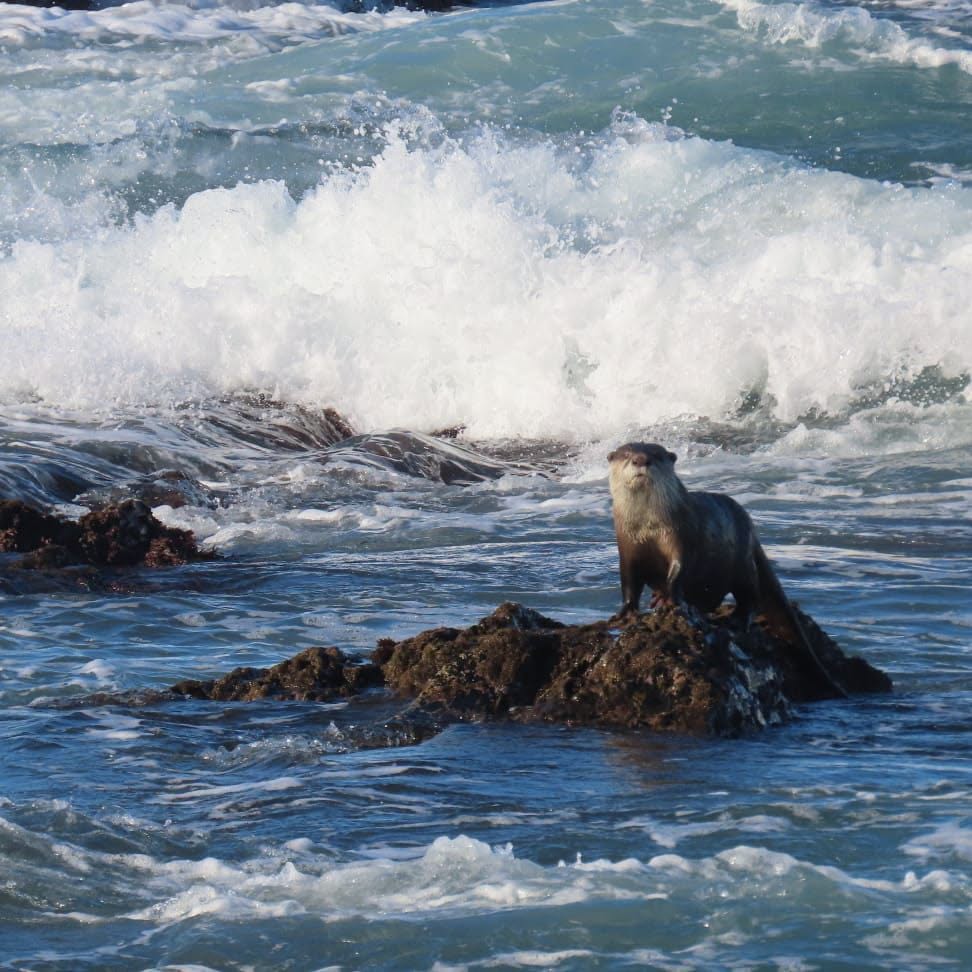
Lauren Moriarty: The Elusive Cape Clawless Otter: Tracking otters along the coast
18th August 2026: Studying the unseen, The African (Cape) clawless otter. Hear the stories and early lessons from tracking otters along the coast.
Cape clawless otters are widespread but rarely seen, and their use of coastal and estuarine habitats remains poorly understood. Lauren Moriarty shares her early findings from ongoing tracking and field observations in the Garden Route, revealing how these elusive predators move through human-influenced coastal systems. It highlights the value of community reports and citizen science in building knowledge, and why understanding these hidden animals is key to protecting healthy, functioning coastal ecosystems.
💙 Why It Matters
By coming to Talk of the Town, you’re helping to:
- Bring environmental education into local schools
- Fund outdoor and field-based learning programmes for disadvantaged youth
- Support community engagement in estuary conservation
Together, we’re growing a community that cares for Knysna’s estuary.
Get Involved
- Come to our next talk — everyone’s welcome!
- Join the WhatsApp group for monthly reminders
- Support the programme by making a donation

-

Talk of the Town: Rabies in Cape Fur Seals
The first talk in the Garden Route on rabies in Cape Fur Seals, was presented by Chanel Visser at the Knysna Yacht Club on Tuesday evening the 29th. South Africa (and Namibia) are making history with the first ever cases of rabies in ocean dwelling mammals. The talk by Senior Marine Field Ranger at Cape…
-

Talk of the Town: Coastal Research Expedition
Tuesday evening saw an enlightening talk by Mark Dixon – founder of Strandloper Project – at the Knysna Yacht Club. The Idyllic, on-the-water setting, lended itself wonderfully to his talk on ocean plastic waste, and their devastating effect on the coastal ecosystem. The audience was enthralled. “I’ve learned so much this evening!” remarks a spectator,…

